SSP Explained: What is a Supply Side Platform and How Does It Work?
What is SSP in programmatic advertising? This complete guide explains what a Supply Side Platform is, how it works, the difference between SSP and DSP, and which SSPs dominate India’s programmatic market — in plain English.
What is an SSP? — The Simple Explanation
Every time you open a website or app and an ad appears — someone sold that ad space in a fraction of a second.
The technology that makes that sale happen on behalf of the publisher — the website or app owner — is called an SSP.
SSP stands for Supply Side Platform.
Think of it this way. A publisher like Cricbuzz has millions of ad slots available every day — every page load, every app open creates a new ad impression. Without technology, Cricbuzz would need a team of salespeople calling hundreds of advertisers individually to sell each slot. That would take forever and leave most inventory unsold.
An SSP solves this problem by automating the selling process. It connects the publisher’s ad inventory to hundreds of potential buyers simultaneously — holding auctions in real time and ensuring every impression gets the highest possible price.
If a DSP is the tool advertisers use to buy ads, an SSP is the tool publishers use to sell ads.
The simplest way to remember it:
- DSP = Demand Side Platform = Advertisers buy here
- SSP = Supply Side Platform = Publishers sell here
Who Uses an SSP?
SSPs are used by publishers — any company that owns digital ad space and wants to sell it programmatically.
This includes:
- News websites — NDTV, Times of India, Hindustan Times, India Today
- Sports apps and websites — Cricbuzz, ESPNcricinfo
- Entertainment apps — MX Player, Zee5, JioSaavn
- CTV platforms — Samsung Smart TVs, Hotstar, JioCinema
- Gaming apps — anyone with a free-to-play mobile game
- Blog networks — any website with significant traffic
- OTT platforms — streaming services running ads
Basically — if a company owns a website, app or TV channel and wants to make money from advertising, they need an SSP.
How Does an SSP Work? — Step by Step
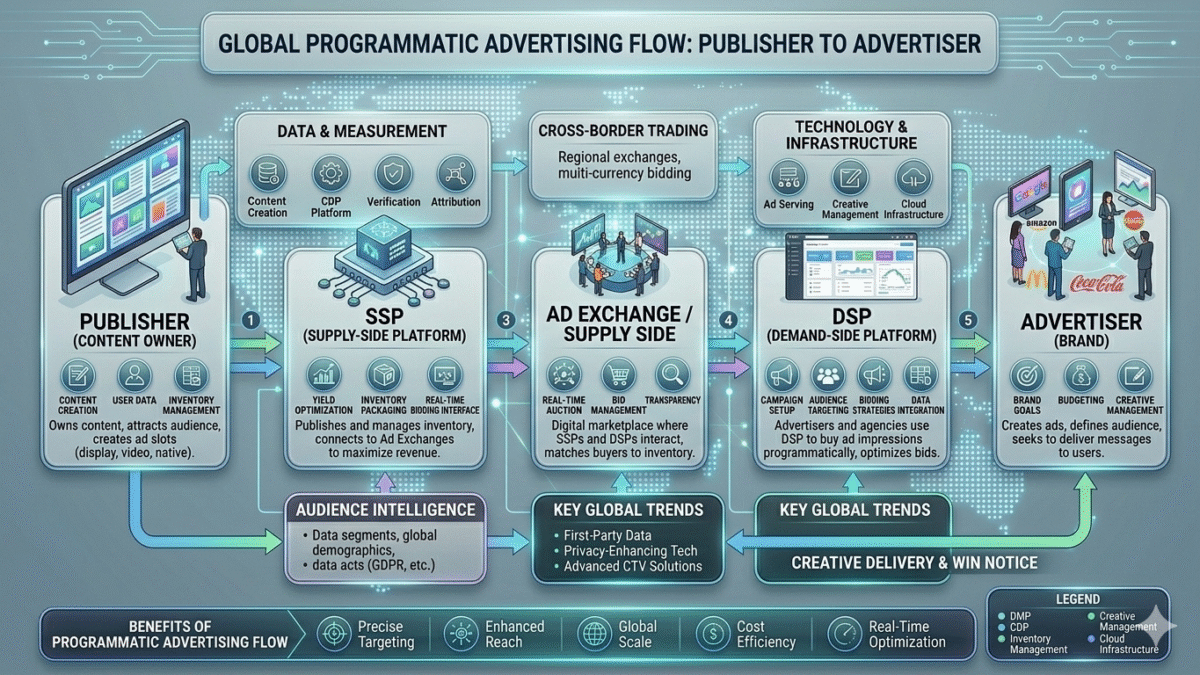
Here is exactly what happens when a user opens a webpage and an ad appears:
Step 1 — User opens a webpage A cricket fan opens the Cricbuzz app to check the IPL scorecard.
Step 2 — Ad request is sent to the SSP The moment the app loads, Cricbuzz’s ad server detects that an ad slot is available and sends a signal to their SSP — in this case, let’s say PubMatic.
Step 3 — SSP packages the impression PubMatic instantly collects all available data about this impression:
- User device type (Android phone)
- User location (Mumbai)
- Page content (IPL match — sports)
- Ad slot size (300×250)
- User audience data (cricket fan, male, 25-35)
- Floor price (minimum price Cricbuzz will accept)
Step 4 — SSP sends bid requests to multiple DSPs PubMatic sends this impression opportunity — called a bid request — to dozens of DSPs simultaneously: DV360, The Trade Desk, Amazon DSP, Xandr and others.
Step 5 — DSPs evaluate and respond Each DSP checks if this impression matches any of their active campaigns. If it does, the DSP calculates how much it is worth and sends back a bid. This happens in milliseconds.
Step 6 — SSP runs the auction PubMatic receives all the bids and runs an auction. The highest bid above the floor price wins.
Step 7 — Winning ad is served The SSP notifies the winning DSP, the ad creative is fetched and displayed on the user’s Cricbuzz app — all within 100 milliseconds.
Step 8 — Revenue is recorded PubMatic records the transaction and passes the revenue — minus their fee — to Cricbuzz.
The entire process — from app open to ad appearing — takes less than the blink of an eye.
What Does an SSP Actually Do? — 6 Key Functions
1. Connects to Multiple Demand Sources
An SSP connects a publisher’s inventory to dozens of DSPs, ad networks and ad exchanges simultaneously. This competition between buyers is what drives up the price the publisher receives.
Without an SSP, a publisher could only sell to one buyer at a time. With an SSP, they can sell to hundreds of buyers simultaneously in a single auction.
2. Runs Real-Time Auctions
Every impression goes through an auction. The SSP manages this auction — collecting bids, comparing them against the floor price and selecting the winner — in milliseconds.
3. Sets and Enforces Floor Prices
The SSP allows publishers to set a floor price — the minimum CPM they will accept for their inventory. If no bid exceeds the floor price, the impression goes unsold (or falls back to a house ad or lower-priority demand source).
Example: Cricbuzz sets a ₹50 CPM floor for their IPL live match inventory. Any bid below ₹50 is automatically rejected.
4. Manages Advertiser Blocks and Brand Safety
Publishers can block specific advertisers, categories or domains from appearing on their inventory. A children’s education app can block alcohol, gambling and adult content categories through their SSP settings.
5. Provides Reporting and Analytics
SSPs give publishers detailed reports on their inventory performance — CPM trends, fill rates, demand source performance, geographical breakdowns and more. This data helps publishers optimise their yield strategy.
6. Optimises Yield
Yield is the revenue a publisher generates from their inventory. A good SSP helps publishers maximise yield by:
- Creating competition among buyers through header bidding
- Setting smart floor prices that maximise revenue without reducing fill rate
- Identifying which demand sources pay best for which types of inventory
- Segmenting premium inventory for private deals vs open auction
SSP vs DSP — The Key Differences
This is the most important comparison in programmatic advertising. Here is a clear breakdown:
| SSP | DSP | |
|---|---|---|
| Stands for | Supply Side Platform | Demand Side Platform |
| Used by | Publishers (sellers) | Advertisers and agencies (buyers) |
| Purpose | Sell ad inventory at maximum price | Buy ad inventory at minimum cost |
| Represents | The sell side | The buy side |
| Goal | Maximise publisher revenue | Minimise advertiser cost |
| Examples | PubMatic, Magnite, Index Exchange, GAM | DV360, The Trade Desk, Amazon DSP |
| Connects to | Multiple DSPs and exchanges | Multiple SSPs and exchanges |
| Runs | The auction | Submits bids to the auction |
Think of it like a property auction:
- The SSP is the auctioneer — running the auction and selling on behalf of the property owner
- The DSP is the buyer’s agent — bidding on behalf of the buyer
- The Ad Exchange is the auction house — the venue where it all happens
- The Publisher is the property owner — receiving the proceeds
- The Advertiser is the buyer — paying for the property
SSP vs Ad Network — What’s the Difference?
Many people confuse SSPs with Ad Networks. Here is the difference:
| SSP | Ad Network | |
|---|---|---|
| Auction type | Real-time bidding — dynamic pricing | Fixed pricing — no real-time auction |
| Transparency | High — publisher sees who is buying | Low — publisher doesn’t know buyers |
| Pricing | Dynamic — changes per impression | Fixed CPM negotiated in advance |
| Control | Publisher has full control | Publisher has limited control |
| Technology | Advanced — header bidding, floor prices | Basic — waterfall delivery |
| Revenue | Higher — competitive auction drives prices up | Lower — fixed rate regardless of demand |
| Examples | PubMatic, Magnite | Google Display Network (older model) |
SSPs have largely replaced traditional ad networks for premium publishers because they generate significantly more revenue through competitive real-time auctions.
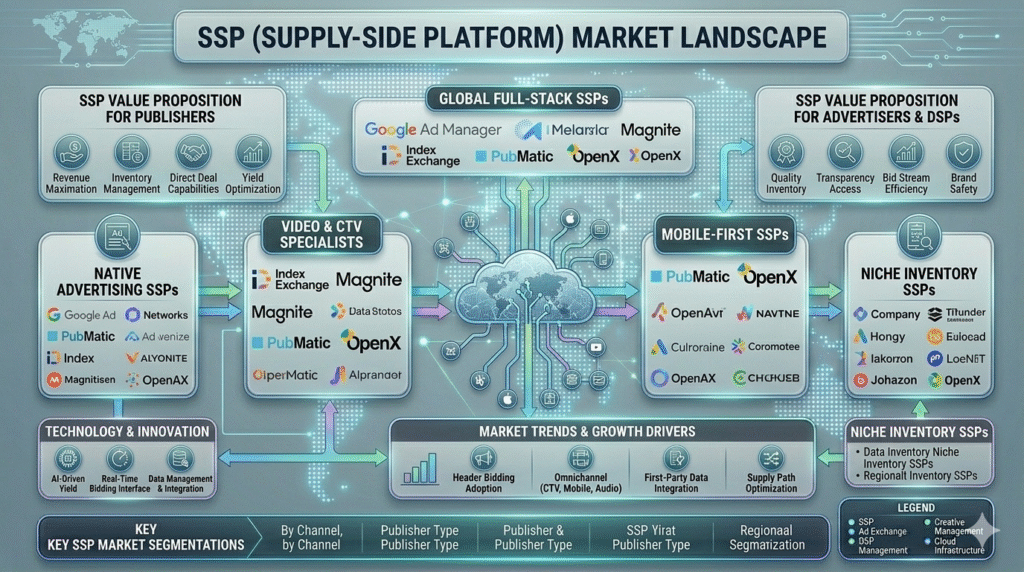
The Major SSPs — Who Are They?
Google Ad Manager (GAM)
The market leader — used by most publishers in India
Google Ad Manager is the world’s most widely used publisher ad server and SSP combined. Almost every major Indian publisher — NDTV, Times of India, Cricbuzz — uses Google Ad Manager as their primary ad serving technology.
GAM connects publishers to Google’s Ad Exchange (AdX) — giving access to Google’s massive demand pool including all DV360 advertisers.
Best for: Publishers of all sizes. Essential if you want access to Google demand.
PubMatic
The largest independent SSP — very strong in India and APAC
PubMatic is one of the world’s largest independent SSPs with a particularly strong presence in India and the Asia Pacific region. Known for its header bidding technology, strong video capabilities and publisher-first approach.
PubMatic does not own demand — meaning it has no conflict of interest between publishers and buyers unlike Google.
Best for: Mid to large publishers wanting strong independent yield optimisation. Very popular with Indian news and entertainment publishers.
Magnite
The world’s largest independent SSP — dominant in CTV
Magnite was formed from the merger of Rubicon Project and Telaria. It is particularly dominant in the Connected TV (CTV) programmatic space and is a key SSP for streaming video publishers globally.
Best for: Video and CTV publishers. Also strong for display and mobile.
Index Exchange
Premium focused — quality inventory curation
Index Exchange is known for its commitment to quality inventory and transparency. It has a strong reputation among premium publishers and buyers who prioritise brand-safe, high-quality placements.
Best for: Premium publishers focused on quality over volume.
OpenX
One of the original programmatic SSPs
OpenX is one of the oldest SSPs in the industry, known for its clean supply and transparency initiatives. Strong in display and mobile web inventory.
Best for: Publishers wanting a reliable, established SSP with good global demand.
InMobi
India’s homegrown SSP — dominant in mobile
InMobi is India’s most successful ad tech company and one of the largest mobile SSPs in the world. Particularly strong for app publishers targeting India and Southeast Asia audiences.
Best for: Mobile app publishers with India-heavy audiences.
Samsung Ads
CTV SSP — Smart TV inventory
Samsung Ads operates the SSP for Samsung Smart TV inventory globally. Publishers and content providers on Samsung TVs sell their CTV inventory through Samsung Ads’ platform, which includes access to unique ACR (Automatic Content Recognition) data.
Best for: CTV content providers and Samsung Smart TV app developers.
Header Bidding — The Most Important SSP Innovation
Before we go further, we need to understand header bidding — the most significant technological innovation in the SSP world in the last decade.
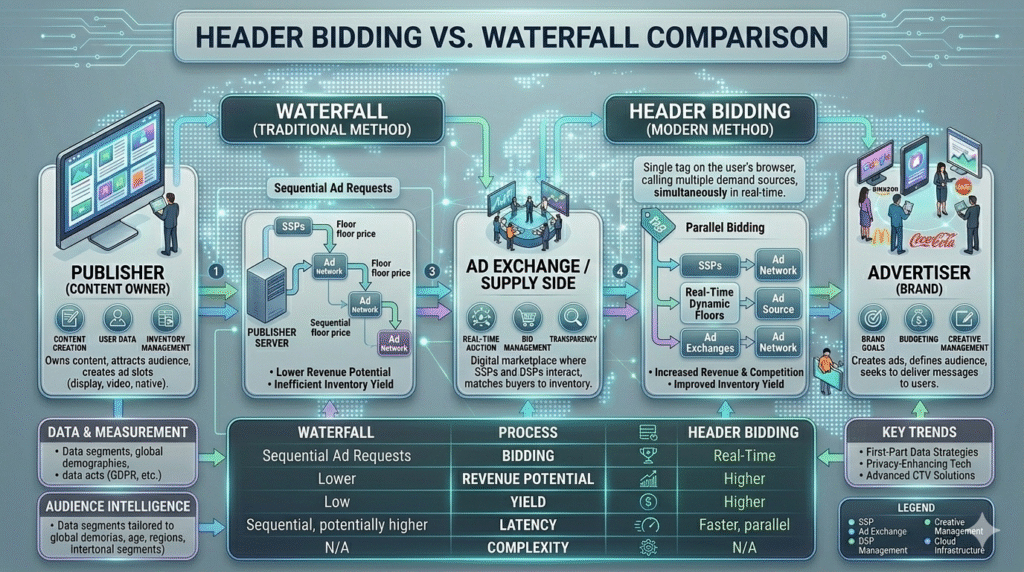
The Old Way — Waterfall
Before header bidding, publishers used a system called the waterfall (also called daisy-chaining):
- Publisher ad server contacts SSP 1 first
- If SSP 1 doesn’t fill, it moves to SSP 2
- If SSP 2 doesn’t fill, it moves to SSP 3
- And so on down the list
The problem: SSPs at the top of the waterfall always had first opportunity regardless of whether they were offering the best price. Publishers consistently left money on the table.
The New Way — Header Bidding
Header bidding changed everything. Instead of contacting SSPs sequentially, header bidding allows a publisher to:
- Send the impression to all SSPs simultaneously
- All SSPs respond with their highest bid at the same time
- The publisher’s ad server selects the overall highest bid — regardless of which SSP it came from
- The winning SSP serves the ad
The result: Publishers see 20-50% revenue increases from implementing header bidding because every impression now goes to a competitive auction among all demand sources simultaneously.
Example: Without header bidding:
- SSP 1 (Google) offered ₹10 CPM → ad served → publisher earned ₹10
- SSP 2 (PubMatic) would have offered ₹18 CPM but was never asked
With header bidding:
- All SSPs bid simultaneously
- SSP 2 (PubMatic) wins with ₹18 CPM → publisher earns ₹18
Key SSP Metrics — What Publishers Track Daily
eCPM (Effective CPM)
The effective revenue per 1,000 impressions. The primary metric publishers use to measure SSP performance.
Formula: eCPM = (Total Revenue ÷ Total Impressions) × 1,000
A higher eCPM means the SSP is generating more value from each impression.
Fill Rate
The percentage of ad requests that resulted in an ad being served.
Formula: Fill Rate = (Filled Impressions ÷ Total Ad Requests) × 100
A 100% fill rate sounds ideal but it often means the floor price is too low. A healthy fill rate is typically 70-85% for premium publishers — the remaining 15-30% rejected because bids didn’t meet the floor.
Win Rate
The percentage of bid requests that resulted in a winning bid above the floor price.
Revenue
Total money earned from the SSP in a given period. Publishers compare revenue across SSPs to identify which delivers the most value.
Viewability Rate
The percentage of served ads that were actually viewable per MRC standards. Higher viewability leads to higher CPMs as advertisers pay more for ads that are actually seen.
How Publishers Choose an SSP — 5 Key Factors
1. Demand Pool
The SSP should connect to a large pool of buyers including major DSPs. More buyers = more competition = higher CPMs.
Question to ask: Which DSPs and ad networks does this SSP connect to?
2. Revenue Share
SSPs charge a percentage of the revenue they generate — typically 10-20%. Publishers should compare net revenue (after SSP fee) not gross CPM.
Question to ask: What is your revenue share and are there any hidden fees?
3. Header Bidding Support
Does the SSP have a reliable header bidding wrapper? How fast is their bid response time? Slow SSPs get timed out of auctions.
Question to ask: What is your average bid response time?
4. Reporting Quality
Can the publisher see granular data — which advertisers are buying, at what CPMs, from which geographies?
Question to ask: Can I see buyer-level reporting in your dashboard?
5. Support Quality
When something goes wrong (and it will), how quickly does the SSP respond? Do they have India-based support?
Question to ask: What is your SLA for support tickets?
SSP in India — The Market Landscape
India’s programmatic advertising market is growing rapidly, and the SSP landscape reflects this:
Google Ad Manager dominates — used by almost every major Indian publisher as their primary ad server.
PubMatic has the strongest independent SSP presence in India with dedicated local teams and strong relationships with major Indian publishers.
InMobi leads in mobile app monetisation for Indian publishers targeting local and APAC audiences.
Index Exchange and Magnite are growing their India presence, particularly for video and CTV inventory.
Samsung Ads is growing rapidly as Smart TV penetration increases in India — particularly relevant for CTV publishers.
The CTV programmatic market in India is the fastest-growing segment — with JioCinema’s IPL streaming and Samsung’s Smart TV growth creating significant new inventory for SSPs.
Common SSP Terms You Will Hear
| Term | Meaning |
|---|---|
| Yield | Total revenue generated from ad inventory |
| Floor Price | Minimum CPM the publisher will accept |
| Fill Rate | % of ad requests filled with a paid ad |
| eCPM | Effective CPM — revenue per 1,000 impressions |
| Waterfall | Old sequential selling method — now mostly replaced |
| Header Bidding | Modern simultaneous auction method |
| Wrapper | The JavaScript code that manages header bidding |
| Prebid.js | Open-source header bidding technology |
| Bid Response | DSP’s reply containing bid price |
| Timeout | Maximum time SSP waits for a bid before moving on |
| Private Deal | PMP or PG deal between specific publisher and buyer |
| Open Auction | Public auction open to all buyers |
| Inventory | All available ad space a publisher can sell |
| Impression | A single ad view — the unit of sale |
| Revenue Share | % SSP takes from publisher revenue |
What’s Next — Continue Learning
Now that you understand SSPs, here are the natural next topics:
Programmatic & Digital Marketing Terms: The complete A–Z glossary of programmatic advertising and digital marketing terms.
DV360 Complete Guide — The most widely used DSP — understanding both sides of the equation makes you a much stronger programmatic professional.
Ads.txt & Sellers.json — How supply chain transparency works and why it matters for both publishers and buyers.
Published by DailyDes — Digital Marketing News & Learning Hub Free programmatic tools for media buyers at tools.dailydes.com